What jurisdiction really means
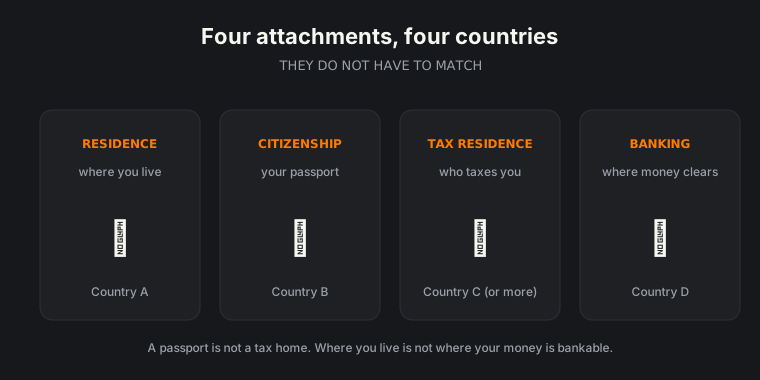
Most people answer "where do you live" with one country. The honest answer is usually several. You might live in one country, hold citizenship in another, bank in a third, keep a hardware wallet in a fourth, and have an heir in a fifth. Each of those connections carries its own rules, and the rules were not written to agree with each other.
Jurisdiction is the set of legal systems that can make a claim on you, your money, your records, or your decisions. It is plural by default. A useful first step is to stop thinking about your "country" and start listing your connections: residence, citizenship, tax residence, domicile, employment, business, property, accounts, documents, advisors, and the people who matter to you.
The point is not that having connections in many countries is bad. It is that the connections need to line up. When they do not, the failure rarely shows up on an ordinary day. It shows up when you move, sell, gift, borrow, disclose, add a co-signer, or die.
The 10 layers of exposure
Exposure is easier to reason about when you separate it into layers. A setup can be strong in one layer and fragile in another, and the fragile layer is the one that decides the outcome.
- Tax. Where you owe, on what, and whether more than one country has a claim.
- Legal. Which courts and laws can compel, freeze, or decide.
- Estate. What happens to your assets and your access when you are gone or incapacitated.
- Banking. Whether you can move money cleanly, and what happens if an account closes.
- Reporting. What information about you flows automatically to which authorities.
- Operational. Whether the system keeps working when a person, device, or provider is unavailable.
- Technical. Key control, device security, and recovery.
- Family. Who knows, who can act, and whether they can tell a real recovery from a scam.
- Concentration. Whether too much depends on one country, one bank, one person, or one phone.
- Fragility in practice. Whether a setup that looks diversified on paper actually holds under pressure.
Bitcoin-specific jurisdiction risks
Bitcoin changes the jurisdiction picture in two directions at once. It reduces some dependencies and creates new responsibilities.
It reduces dependency because self-custodied Bitcoin does not need a bank to remain yours, and it does not stop existing because an account was closed. That is real. It is also where many people stop thinking, and that is the mistake.
The new responsibilities are the part that gets missed. Self-custody moves the burden of records, recovery, and inheritance onto you. A tax authority that treats Bitcoin as property expects you to track disposals. An estate process that grants legal authority to an executor does not grant that executor the keys. A country can make Bitcoin perfectly legal to own and still make it hard to convert to local money through a bank. None of these are wallet problems. They are jurisdiction problems that a wallet cannot solve.
A separate point worth holding: Bitcoin is not the same as crypto in general. Some jurisdictions classify and regulate Bitcoin differently from tokens, stablecoins, or securities. Where that distinction matters for tax or reporting, the country library treats it as a distinction, not a footnote.
Tax visibility and reporting
Tax exposure is the layer people most often underestimate, because it is rarely about a single country. Residence, citizenship, source of income, company ownership, account location, and exchange records can each create an obligation, and they can overlap.
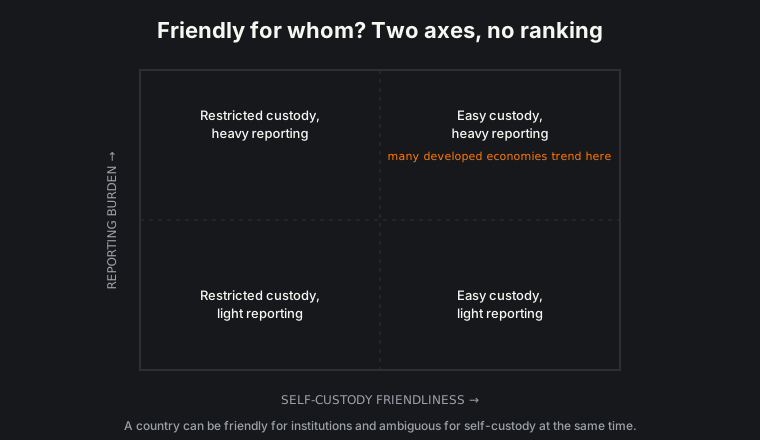
Two ideas do most of the work here. The first is the difference between legal residence and tax residence. You can be a legal resident of one country and a tax resident of another, or of more than one, depending on day counts, domicile, and the source of your income. The second is the global shift toward reporting. Frameworks like the Common Reporting Standard and the newer Crypto-Asset Reporting Framework, along with broker reporting rules inside individual countries, mean that more of your activity becomes visible to more authorities over time. Reporting is not the same as confiscation. It does change planning, because it removes the assumption that anything is invisible.
The practical exposure is usually not a single dramatic liability. It is thin records meeting overlapping obligations. If you cannot show where Bitcoin was acquired, what it cost, and what you did with it, the cost is paid later in a tax or estate review.
Estate, inheritance, and forced heirship
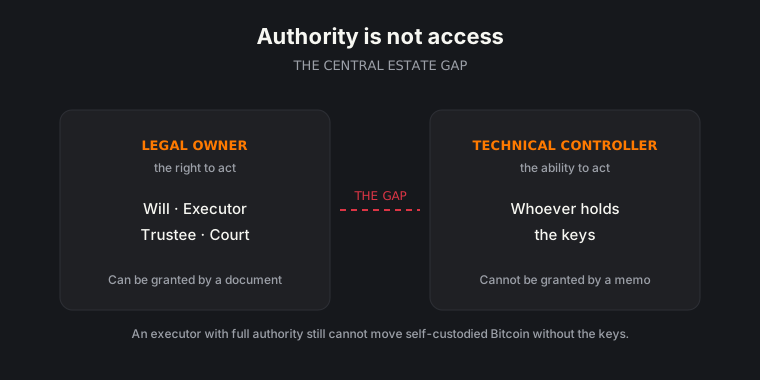
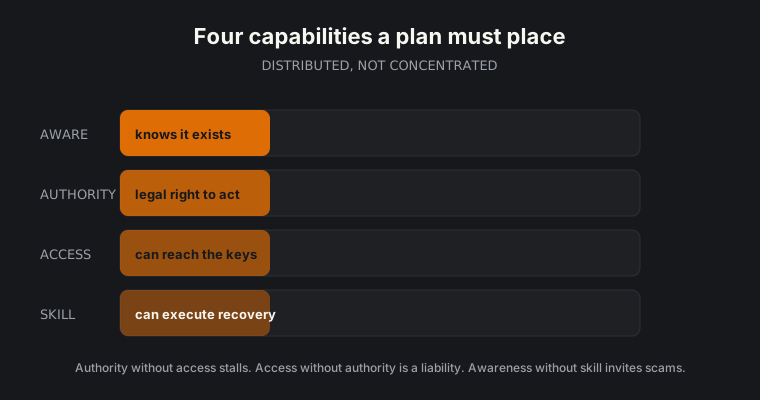
Estate exposure is where the gap between legal authority and technical access becomes concrete. An executor or a trustee can hold complete legal authority over your estate and still be unable to move a single satoshi, because authority is a legal right and access is control of keys. They are held by different mechanisms and sometimes by different people.
Two structural facts shape this layer. The first is forced heirship. Civil-law countries often reserve a portion of an estate for certain heirs by law, which limits how freely you can direct assets by will. Common-law countries usually allow more testamentary freedom but add their own features, such as spousal claims. The second is recognition across borders. A will that is valid in one country may not be recognized cleanly in another, and a trust or foundation that works in one legal system may not be understood in another.
The recurring failure is a plan that is technically excellent and legally undefined: good custody, no clear owner, no executor instructions, and no safe path for the family to reach the records without reaching the secrets.
Banking, liquidity, and de-risking
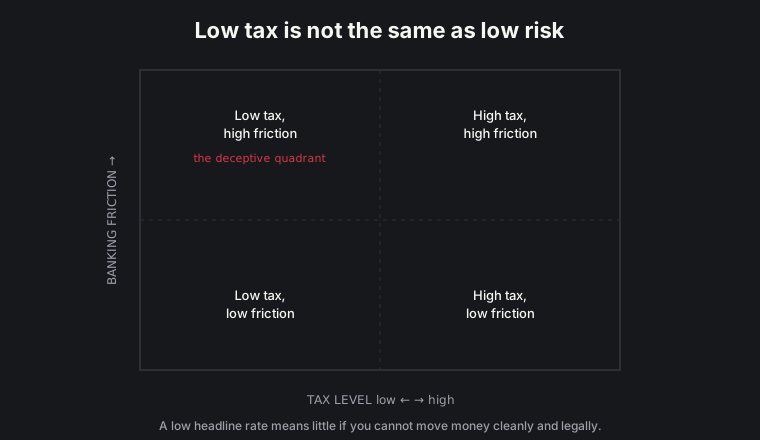
Legal does not always mean bankable. A country can permit Bitcoin and still have banks that close accounts after a crypto-related wire, delay transfers, or demand source-of-funds documentation that takes weeks to satisfy. Banking is its own layer, and it is often more fragile than people assume because it usually works until it suddenly does not.
The useful test is resilience. If one bank froze or closed your main account tomorrow, with no warning, could you cover essentials for ninety days, and could you move money cleanly and legally in the meantime? Concentration is the hidden risk here: one bank, one exchange, one phone, one email, or one app can be the single point that the whole system depends on.
Self-custody, collaborative security, and legal authority
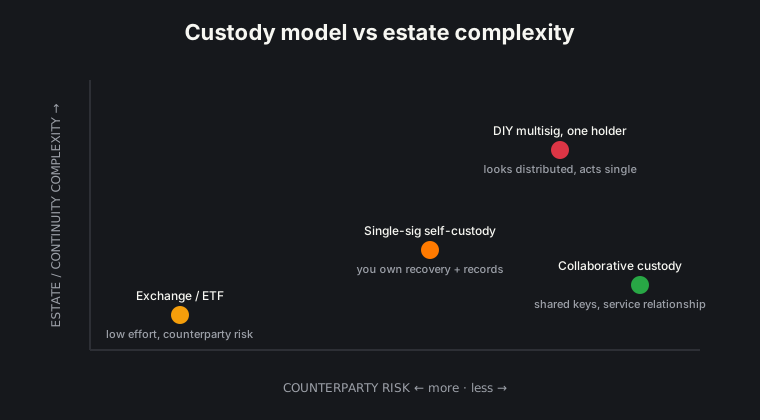
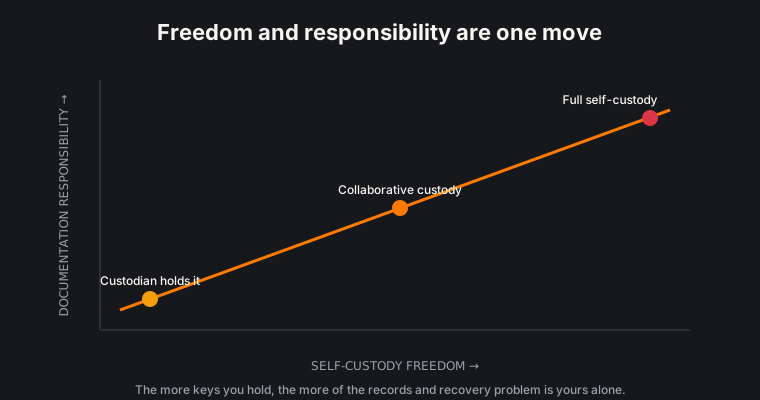
Self-custody is a freedom and a responsibility, and the two arrive together. Holding your own keys removes counterparty risk. It also makes you the sole owner of the recovery problem, the records problem, and the inheritance problem.
The distinction that matters across this module is between control and authority. Single-signature self-custody concentrates control in one person and one process. DIY multisig where one person holds every key looks like distributed security but is operationally a single point, because the same person is still the only one who can act. Collaborative custody spreads key control across parties, which can ease continuity at the cost of a service relationship. None of these is correct in the abstract. The right structure depends on who needs to act, when, with what authority, and what happens if the primary person is unavailable.
Cross-border families
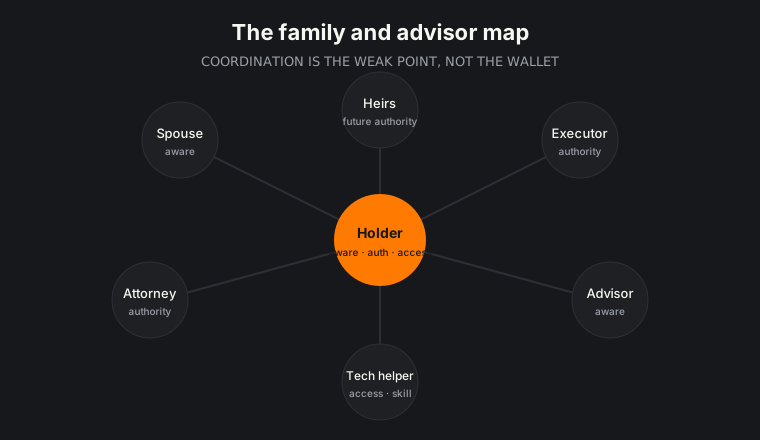
For families that span borders, the wallet is rarely the weak point. Coordination is. The classic failure looks like this: heirs in one country, legal documents in another, keys in a third, and advisors in a fourth, with no single person who understands how the pieces connect.
A few questions expose most of the risk. Do your heirs and your executor live where your documents are valid and in a language those documents are written in? Does anyone in the family know the Bitcoin exists and who to call? If they do, could they tell a legitimate recovery process from a scam, since the two can look similar under pressure? And does anyone hold too much: a person with both full authority and full access, or full information, is a concentration risk as real as a single bank.
Business and family-office exposure
For businesses and family offices, exposure adds layers that individuals do not face: corporate ownership structure, treasury policy, signer authority, accounting and tax treatment, banking rails, board approval, and succession. Bitcoin held by an entity inherits all of the entity's jurisdictional complexity and adds key-person risk on top.
The questions that matter most are governance questions. Is there a written treasury and signer-authority policy, or is it informal and held in one person's head? If the main signer were unavailable, could the business still operate the treasury? Is the accounting treatment defined, and does it match the tax position?
How to build your own exposure map
You can build a useful first version of your map in one sitting, without sharing anything sensitive. The method is to list connections, then test them.
Start by listing every country that touches your life and what role it plays. Then, for each form of Bitcoin exposure you hold, answer four questions: who can move it, who knows it exists, who has the legal authority, and what happens if you are unavailable. Next, do the same for money: how many banks, in how many countries, and how long you could last if one closed. Then look at your documents and sort them. Finally, run a short stress test: a bank freeze, a sixty-day absence of the key person, a move that might change your tax residence.
The country research library
The library holds structured profiles, one per jurisdiction, built on the same template so you can compare like with like. Each profile covers tax, Bitcoin regulation, reporting, estate and succession, banking reality, asset protection, residency and mobility, and a careful read of the direction the country is moving.
Two principles govern the library. The first is that there is no ranking. There is no "best country for Bitcoin," because fit depends on your facts. A jurisdiction can be attractive for one reason and fragile for another. The second principle is honesty about uncertainty. Every claim carries a confidence level and a source, every profile shows when it was last reviewed, and anything that cannot be confirmed is marked as an open question for local counsel rather than presented as fact.
The first cohort is the United States, Colombia, Panama, El Salvador, Australia, and Switzerland. The United States profile is the most developed and shows the depth the others are built toward.
Next steps and professional review
The audit ends with a map, not a verdict. The map names your primary exposure, lists the flags by layer, and gives you a short list of questions to bring to the right professional: a tax advisor for the tax layer, an estate attorney for succession, an immigration attorney for residency and mobility, a custody specialist for the technical and recovery layer, and corporate counsel for business structure.
Use the output as a preparation document for those conversations. It is built to make the meeting shorter and sharper, because you arrive knowing which questions matter for your situation. The goal is clarity. The decision stays with you and the professionals you choose.